




The recently published paper unveils the nature of CD99, which mediates immune synapse formation (or, cytoskeleton rearrangement), which potentiates CAR-T cell tumor-killing potential. The research team demonstrated at the molecular level that CD99, a membrane protein, stabilizes the immune synapse through actin-microtubule reorganization within T cells during the immune synapse formation process between T cells and antigen-presenting cells.
The research team conducted development research to apply it to CAR-T cells. In existing CAR-T cells, the transmembrane region had no other function reported other than to connect the external antibody region that recognizes the antigen and the internal signaling region of the T cell and anchor it to the cell membrane.
However, the research team replaced this region with the transmembrane region of CD99 to produce CAR-T cells. The team confirmed that the immune synapse formed with tumor cells was more stable, resulting in a significant increase in tumor killing ability.
CAR-T cell therapy consists of three components: a tumor-specific antibody, a T cell, and the CAR construct that connects and activates the T cell. Currently, most CAR-T therapy development focuses mainly on replacing the tumor-specific antibody portion, with only a few leading groups attempting to enhance the immune activity of the T cell itself or improve the CAR backbone. However, these improvements have focused on the signaling domain within the T cell, effectively making the process of creating an entirely new CAR-T cell an arduous process.
|
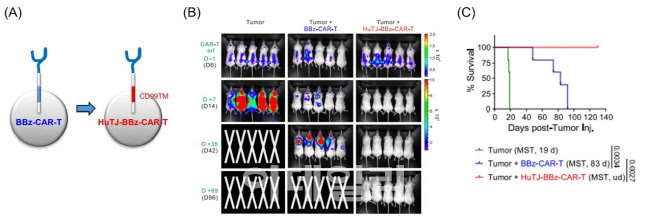
Moreover, because this new potency enhancement strategy does not require additional gene transduction space within the T cell, it can also be applied to the development of next-generation CAR-T cells that will incorporate additional function-enhancing genes.
As evidence, the company has confirmed through joint research with Australia’s Cartherics that CLIP-CAR technology enhances tumoricidal activity in CAR-iNK cells and has filed a joint patent for this. Furthermore, a major US research institute is conducting research to apply TiCARos’ CLIP technology to its own CAR-T cells.
Meanwhile, clinical trials for a lymphoma treatment (codename TC011) utilizing CLIP CAR technology are currently underway at Seoul National University Hospital, Samsung Medical Center, and other institutions. To date, the trial has demonstrated remarkable results, with all patients evaluated across the low-dose, medium-dose, and high-dose cohorts achieving complete remission (100% complete remission, 100% objective response rate).
In addition, TiCARos published its safety-enhancing Switchable CAR-T technology in Nature Communications last year as well. It also possesses a Converter CAR-T platform that enhances the immune activity of T cells themselves, allowing them to act exclusively on tumors. This effectively provides the technology to enhance the efficacy and safety of all components of CAR-T cell therapy.


![삼전닉스보다 더 뜨겁다…마이크론 깜짝 실적에 뜨는 소부장[종목e슈]](https://image.edaily.co.kr/images/vision/files/NP/S/2026/10/PS26100300289t.jpg)
!["역에서 나오자마자 집?"…서울 7억대 아파트 3곳 가보니[랜선임장]](https://image.edaily.co.kr/images/vision/files/NP/S/2026/10/PS26100300386t.jpg)

![집 팔았는데 돈도 사람도 그대로…'2분 13초'의 비밀[세금, 그 후]](https://image.edaily.co.kr/images/vision/files/NP/S/2026/10/PS26100300011t.jpg)
![[그해 오늘] 27살 출소? 40대 성폭행 뒤 웃은 중학생, 감옥서 '엽기 범죄'](https://image.edaily.co.kr/images/vision/files/NP/S/2026/10/PS26100300003t.jpg)