This article was released as Pharm Edaily Premium Content on September 29, 2026, at 8:00 AM.
[Yu Jin-hee, Edaily Reporter] The driving force behind the Kosdaq rebound on the 28th was the pharmaceutical, biotechnology, and medical device(bio) sector, led by the HLB Group. Breaking through macroeconomic uncertainties and a prolonged period of market adjustment, frozen investor sentiment in the bio sector thawed rapidly as tangible milestones converged—including regulatory approvals from global agencies, the establishment of overseas beachheads, and the validation of next-generation drug platforms. Market participants evaluate the broad daily limit rally as an important turning point signaling the return of warmth to the broader bio industry.
|

Historic US FDA Full Approval for ‘LYRFIGTU’…10 HLB Group Affiliates Hit Daily Limit in Tandem
According to financial data provider KG Zeroin MP DOCTOR, as many as 12 bio companies entered the domestic stock market’s top 15 daily gainers list on the day. Signaling the start of the rally, HLB Therapeutics surged 30.00% to close at its upper limit of 9,620 KRW. Following suit, 10 affiliated companies of the HLB Group including HLB, HLB Life Science, HLB Panagene, and HLB Innovation all locked in daily upper price limits, creating an extraordinary market spectacle.
Medical artificial intelligence(AI) specialist VUNO jumped 29.98% to 7,240 KRW, while BNC Korea, which demonstrated validation data for its obesity therapy platform, also surged 29.98% to 3,425 KRW, jointly reinforcing the sector-wide momentum.
Market experts observe that the bio investment landscape, previously swayed by vague thematic expectations, is realigning around companies that prove tangible business execution through clear clinical data, overseas regulatory approvals, and export contracts. HLB, VUNO, and BNC Korea each stand at a strategic crossroads powered by distinct fundamental catalysts.
The spark igniting aggressive buying across HLB Group stocks was the US Food and Drug Administration(FDA) approval of the targeted cholangiocarcinoma(bile duct cancer) therapy LYRFIGTU (ingredient name: lirafugratinib). News announced just prior to the Chuseok holiday filtered into the first trading session after the break, triggering limit-up surges across the group's listings.
Elevar Therapeutics, the US subsidiary of HLB, announced on the 23rd(local time) that the US FDA approved LYRFIGTU as a second-line therapy for adult patients with previously treated, unresectable locally advanced or metastatic cholangiocarcinoma harboring fibroblast growth factor receptor 2(FGFR2) gene fusions or other rearrangements.
Elevar secured global commercialization rights to the drug from US-based Relay Therapeutics in 2024 and plans to roll out the therapy in the US market during the fourth quarter of this year. Market enthusiasm was heightened because LYRFIGTU secured a "Full Approval" with no mandatory post-marketing confirmatory trial requirements, unlike existing competitor agents—Incyte’s Pemazyre and Taiho Oncology’s Lytgobi—which entered the market via accelerated approval pathways. In rare cancer spaces where patient recruitment and confirmatory trials are difficult, this clearance removes critical regulatory overhang.
Clinical efficacy and safety metrics also stood out. In the Phase 1/2 clinical study serving as the basis for FDA approval, LYRFIGTU demonstrated an objective response rate(ORR) of 46% and a median duration of response(mDoR) of 11.8 months, exceeding the 30% to 40% response figures seen in earlier treatments. By selectively targeting FGFR2 and minimizing the inhibition of off-target FGFR family members, the incidence of side effects like hyperphosphatemia was lowered to around 20%.
Clear hurdles remain. The annual incidence of newly diagnosed cholangiocarcinoma in the US stands at approximately 8,000 cases, with FGFR2 fusions presenting in only about 15% of intrahepatic cases. As the initial target addressable market is niche, commercial penetration will depend on prescription market share battles against incumbent Pemazyre(annual net sales of roughly 120 billion KRW), as well as Elevar's execution across US distribution networks and reimbursement listings.
HLB is accelerating label and territory expansions to broaden commercial potential. The company submitted a Marketing Authorization Application(MAA) to the European Medicines Agency(EMA) this month and is executing the global Phase 2 ‘ReFocus202’ clinical trial across non-cholangiocarcinoma solid tumors, targeting FGFR2 alterations under a tumor-agnostic strategy.
"The full FDA approval of LYRFIGTU in cholangiocarcinoma is a beginning rather than an end," said HLB Group Chairman Jin Yang-gon. "We will maximize therapeutic value by expanding indications across diverse solid tumor types and advancing combination regimens with pipeline candidates from global pharmaceutical leaders."
|
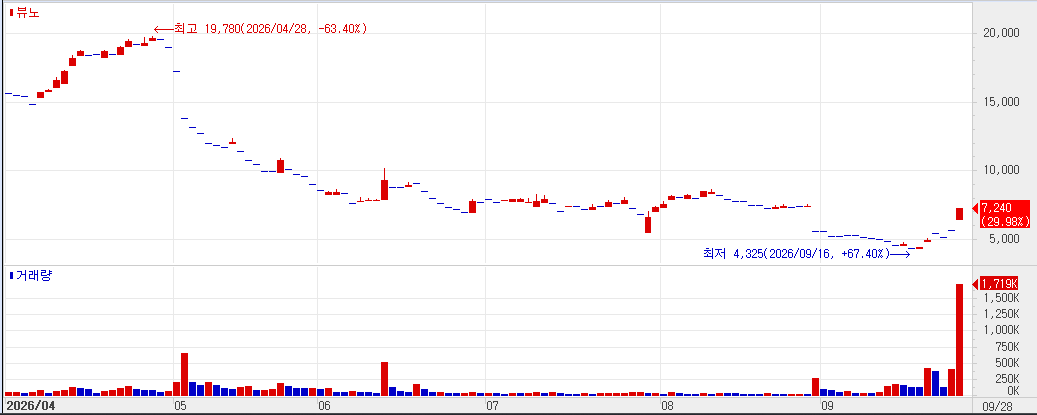
Unlocking China’s Hainan Medical Zone…VUNO Rallies on Exclusive Commercial Contract
Leading medical AI company VUNO surged to its price ceiling after delivering overseas expansion news into China, the company's largest potential regional market. VUNO announced on the 28th that it signed an exclusive two-year distribution agreement with Chinese medical firm Guorun for its AI-powered cardiac arrest risk prediction system, VUNO Med-DeepCARS, in Hainan Province.
Under the agreement, the two companies will conduct a Proof of Concept(PoC) across key hospital sites within the Boao Lecheng International Medical Tourism Pilot Zone.
The Boao Lecheng Pilot Zone operates a special administrative framework allowing medical devices and therapies approved outside China to be utilized within designated hospitals prior to formal national regulatory clearance. VUNO aims to complete hospital administrative registrations within six months, using the pathway to collect local real-world clinical data and commercial usage records to expedite formal National Medical Products Administration(NMPA) approval across mainland China.
Concurrently, VUNO’s AI fundus analysis software, VUNO Med-Fundus AI, completed integration with the chronic disease management platform of Chinese partner BioVision, with commercial supply agreements being pursued across public medical centers in Yangzhou, Jiangsu Province. The dual-track strategy aims to tap into China’s primary healthcare institutions, where ophthalmic specialists are scarce.
However, behind the upper-limit bounce lie unresolved structural risks and the reality of a substantial rights offering. Following CEO Lee Ye-ha's executive return, VUNO divested non-core assets to focus resources on DeepCARS. As a result, first-half revenue for DeepCARS reached 10.4 billion KRW, accounting for 85.8% of the company's total first-half top line of 12.2 billion KRW, signaling high reliance on a single product.
DeepCARS’s domestic evaluation deferral period ended in March, and the device is currently undergoing New Health Technology Assessment by the National Evidence-based Healthcare Collaborating Agency(NECA). While deployed across 154 general hospitals, a failure to pass the assessment would halt non-reimbursed clinical use and wipe out over 85% of company revenue, creating a major business continuity risk that could trigger listing eligibility reviews. Meanwhile, US expansion suffered delays after receiving an NSE(Not Substantially Equivalent) finding under the FDA 510(k) pathway in April, with resubmission preparations targeting later this year.
Financial pressures from accumulated deficits persist. Having logged a net loss of 9.4 billion KRW in the first half, VUNO resolved a 31.4 billion KRW rights offering with existing shareholders followed by a public offering of forfeited shares. As 20 billion KRW is earmarked to retire perpetual convertible bonds (CB), remaining capital for R&D and regulatory milestones is tightly constrained. CEO Lee's planned commitment to take up roughly 7% of his allocated subscription could dilute his equity stake down to around 11%, adding to governance management pressures.
"The entry into China’s pilot medical zone is a meaningful breakthrough, but VUNO's ultimate operational trajectory depends on passing Korea's New Health Technology Assessment and successfully clearing FDA resubmission in the fourth quarter," commented a medical AI industry source. "The company must secure core operational cash flows within the runway bought by the 31.4 billion KRW capital raise."
|
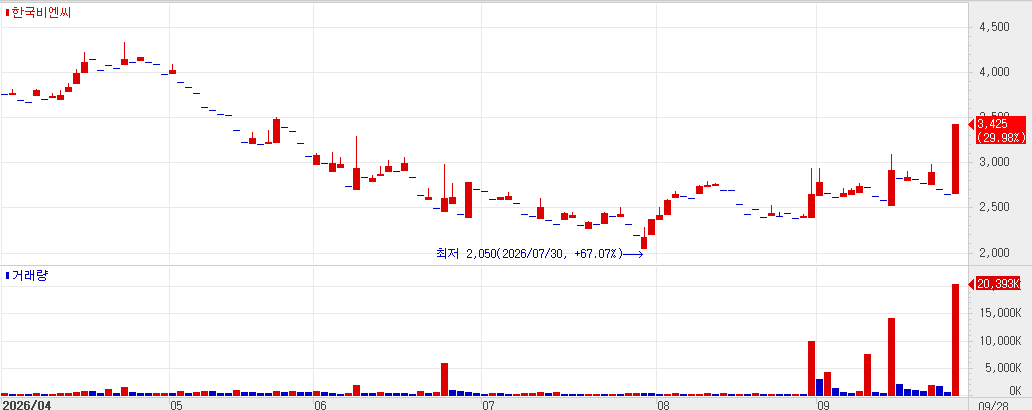
Achieving Up to 30% Weight Reduction in Animal Models…BNC Korea Advances Triple-Agonist Obesity Pipeline
BNC Korea locked in the upper limit following the release of non-clinical data for its long-acting triple-agonist obesity therapy candidate, co-developed with ProAppTec. Speculative and institutional buying converged after the study suggested efficacy surpassing existing market standards Wegovy and Mounjaro.
According to BNC Korea, repeated six-week administration of the candidate—engineered through AI-assisted peptide design and site-specific conjugation platform technology—achieved up to roughly 30% body weight reduction in diet-induced obesity(DIO) mice. Under identical experimental conditions, the control group treated with Novo Nordisk’s Wegovy(semaglutide) recorded weight loss of up to 23%.
The candidate acts simultaneously on three metabolic receptor targets: glucagon-like peptide-1(GLP-1), glucose-dependent insulinotropic polypeptide(GIP), and glucagon(GCG). By concurrently suppressing appetite, stimulating insulin secretion, and elevating energy expenditure, the agent aims to maximize overall weight reduction efficiency.
The candidate also demonstrated suppression of weight regain following treatment cessation. The weight recovery rate post-treatment was 27.3%, significantly lower than the 47.4% observed in the Wegovy and Mounjaro(tirzepatide) arms. The developers interpret this as non-clinical evidence that weight-loss benefits may persist longer after stopping drug administration.
In vivo half-life was also extended. In human FcRn transgenic mice that model human albumin recycling dynamics, the candidate’s terminal half-life reached approximately 41 hours—roughly five times longer than Wegovy’s seven hours under equivalent settings. This profile introduces the technical possibility of advancing from once-weekly to once-monthly dosing regimens.
Market analysts advise maintaining perspective regarding early preclinical animal figures. Triple-agonist peptide candidates present complex safety margins, including heart rate acceleration and gastrointestinal tolerability, and rodent pharmacodynamics frequently face clinical translation hurdles in human subjects.
BNC Korea plans to finalize lead candidate selection based on these findings and compile non-clinical safety, pharmacokinetic(PK), and chemistry, manufacturing, and controls(CMC) packages to pursue global licensing-out(L/O) agreements and investigational new drug(IND) applications in tandem.
"These results validate both the potent weight-reduction efficacy of our co-developed triple-agonist candidate and its therapeutic potential as an extended-interval sustained-release agent at the preclinical stage," said Choi Wan-gyu, CEO of BNC Korea. "Through rigorous subsequent non-clinical evaluations, we will advance this program into a globally competitive next-generation obesity therapeutic.“



![[그해 오늘]'냉장고 속 11개월'…여친 살해 후 8800만원 가로챈 남친](https://image.edaily.co.kr/images/vision/files/NP/S/2026/09/PS26093000230t.jpg)